Back to Blog
Tutorial
Jul 28, 2026
5 min read
How to Deploy and Run Hermes on a GPU Slice
Deploy Nous Research's 405B-parameter Hermes 3 model efficiently using a 48GB GPU slice and FP8 quantization.
Hermes 3 is Nous Research's 405B-parameter language model — one of the most capable open-weight LLMs available. It's also enormous: the full model requires over 200GB of VRAM, which means you need at least three H100s or four A100s to load it without quantization.
Unless you use a GPU slice.
GPU slicing lets you run large models on a fraction of a GPU by sharing the remaining capacity with other workloads. Instead of paying for an entire H100 (80GB) that you only half-use, you pay for a 48GB slice — exactly what Hermes needs in 4-bit quantization. Here's how to deploy it on Istidlal in under five minutes.
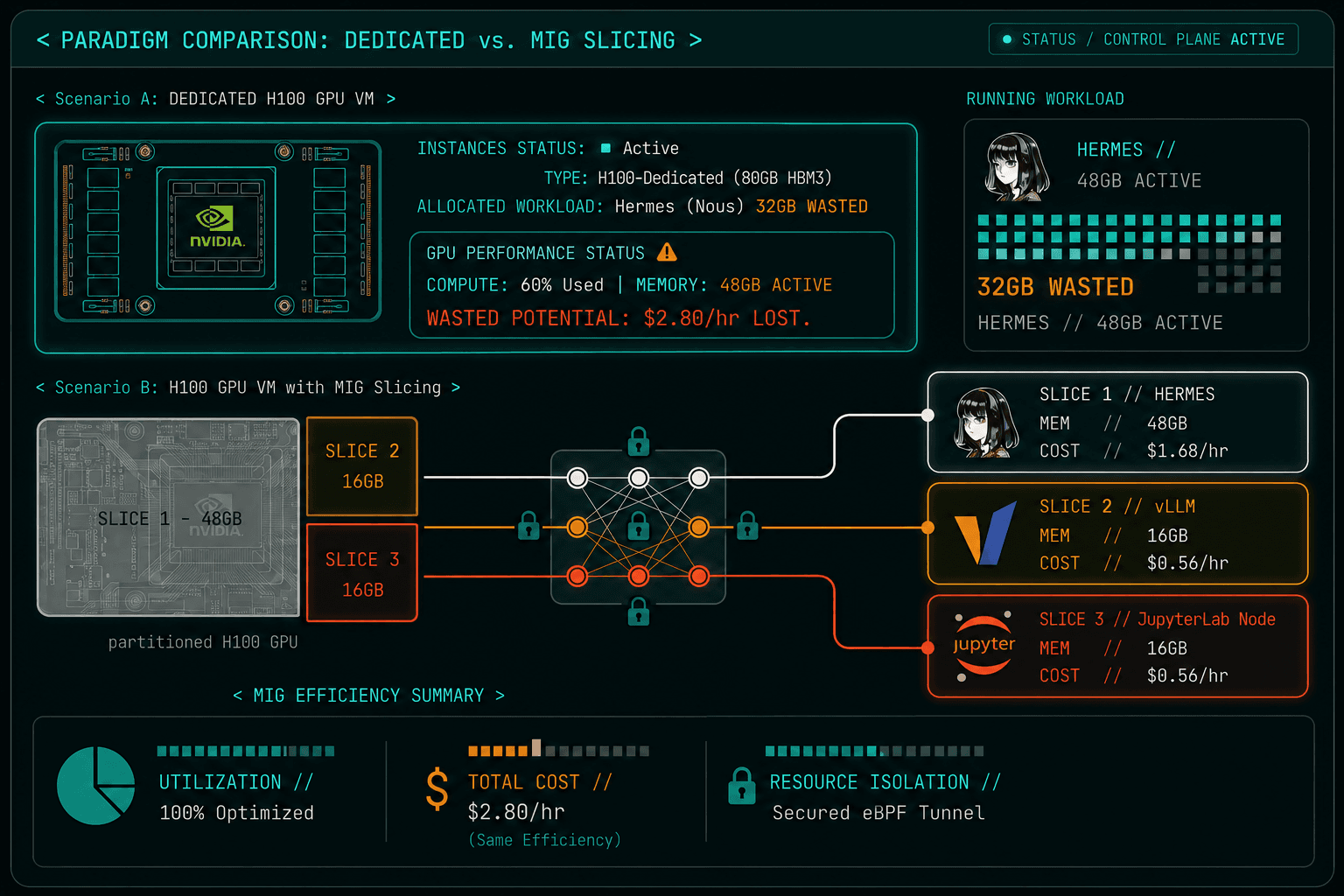
GPU Allocation Comparison
What You'll Need
- An Istidlal account with GPU access
- The Hermes 3 model (automatically downloaded on first run)
- About 48GB of VRAM (one H100 slice or equivalent)
Step 1: Create a GPU Slice Function
From the dashboard, create a new function with these settings:
yaml
The
mode: shim tells the platform to use GPU virtualization instead of dedicated hardware. Your function shares the physical GPU with other workloads, but the broker enforces VRAM quotas and CUDA isolation — your model can't see or interfere with other tenants.Step 2: Configure the Model
Add the model arguments:
yaml
The
fp8 quantization reduces VRAM usage from ~200GB to ~50GB, fitting comfortably in a 48GB slice. The max-model-len of 8192 gives you decent context length without exhausting KV cache space.Step 3: Deploy
Click Deploy. Behind the scenes, the platform:
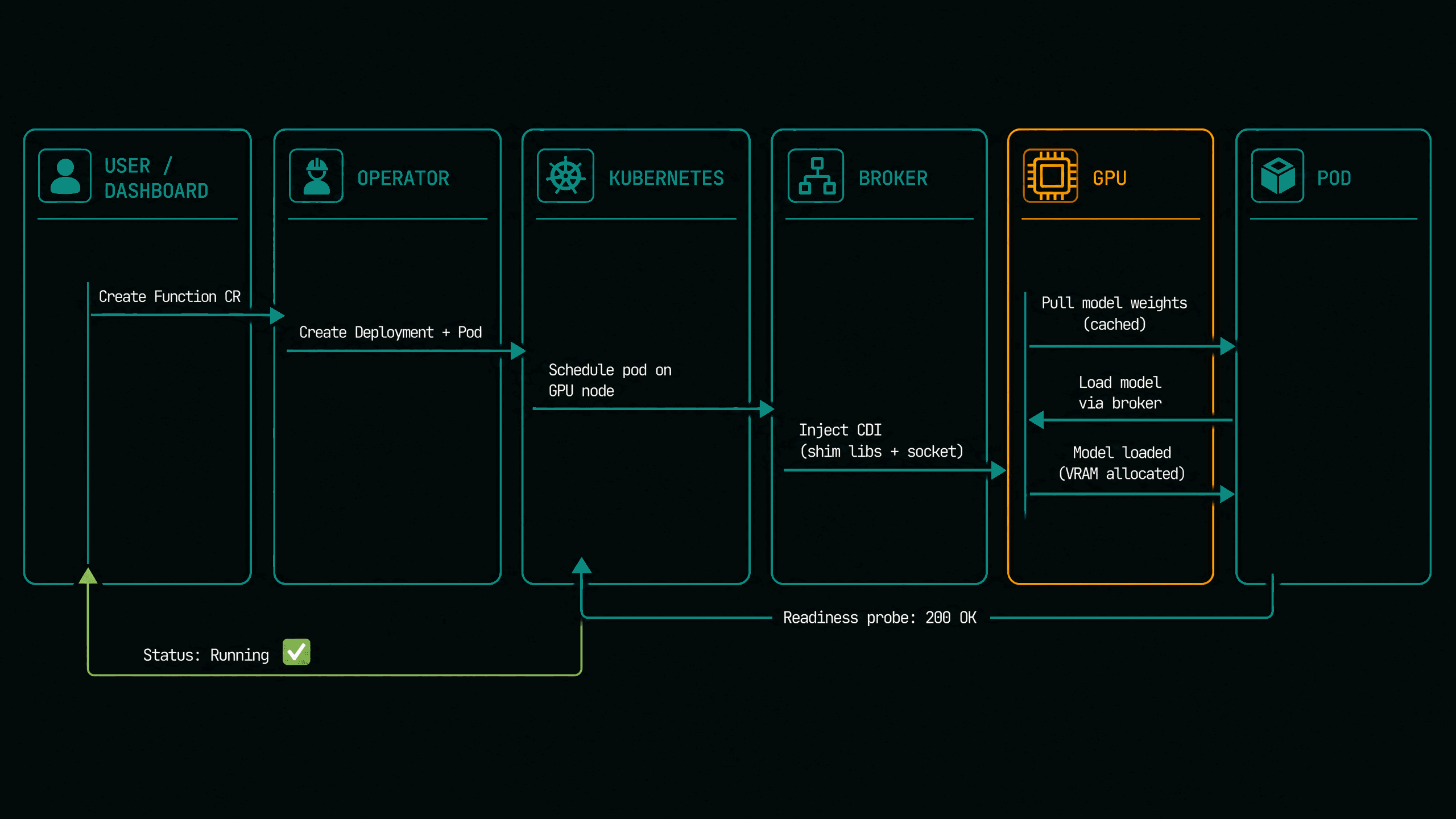
- Provisions a GPU slice on an available node
- Pulls the vLLM container image (cached after first deploy)
- Downloads the Hermes 3 weights from Hugging Face (cached on subsequent deploys)
- Starts vLLM, loads the model into VRAM
- Registers the function endpoint
First deploy takes 3-5 minutes (mostly model download). Subsequent deploys with the same model take under 30 seconds.
Step 4: Chat with Your Model
Once the function is
Running, you get an endpoint:awk
Via the browser
Open that URL. You'll be prompted to sign in with Google. After authentication, the vLLM chat interface loads automatically.
Via the API
Mint an API key from the dashboard, then:
shell
From Python
python
What's Happening Under the Hood
Your function runs on a GPU slice — a fraction of a physical GPU isolated by our broker. The broker intercepts every CUDA call through LD_PRELOAD libraries, forwards it to the real GPU, and enforces per-tenant VRAM limits. Your function sees exactly 48GB of GPU memory, even though the physical H100 has 80GB — the remaining 32GB is allocated to other tenants running on the same GPU.
This means:
- You pay for what you use, not for the whole GPU
- Multiple models can share one H100 without MIG hardware partitioning
- GPU utilization stays high — the broker fills idle capacity with other workloads
- Isolation is enforced — your VRAM quota is hard, not advisory
Cost Comparison
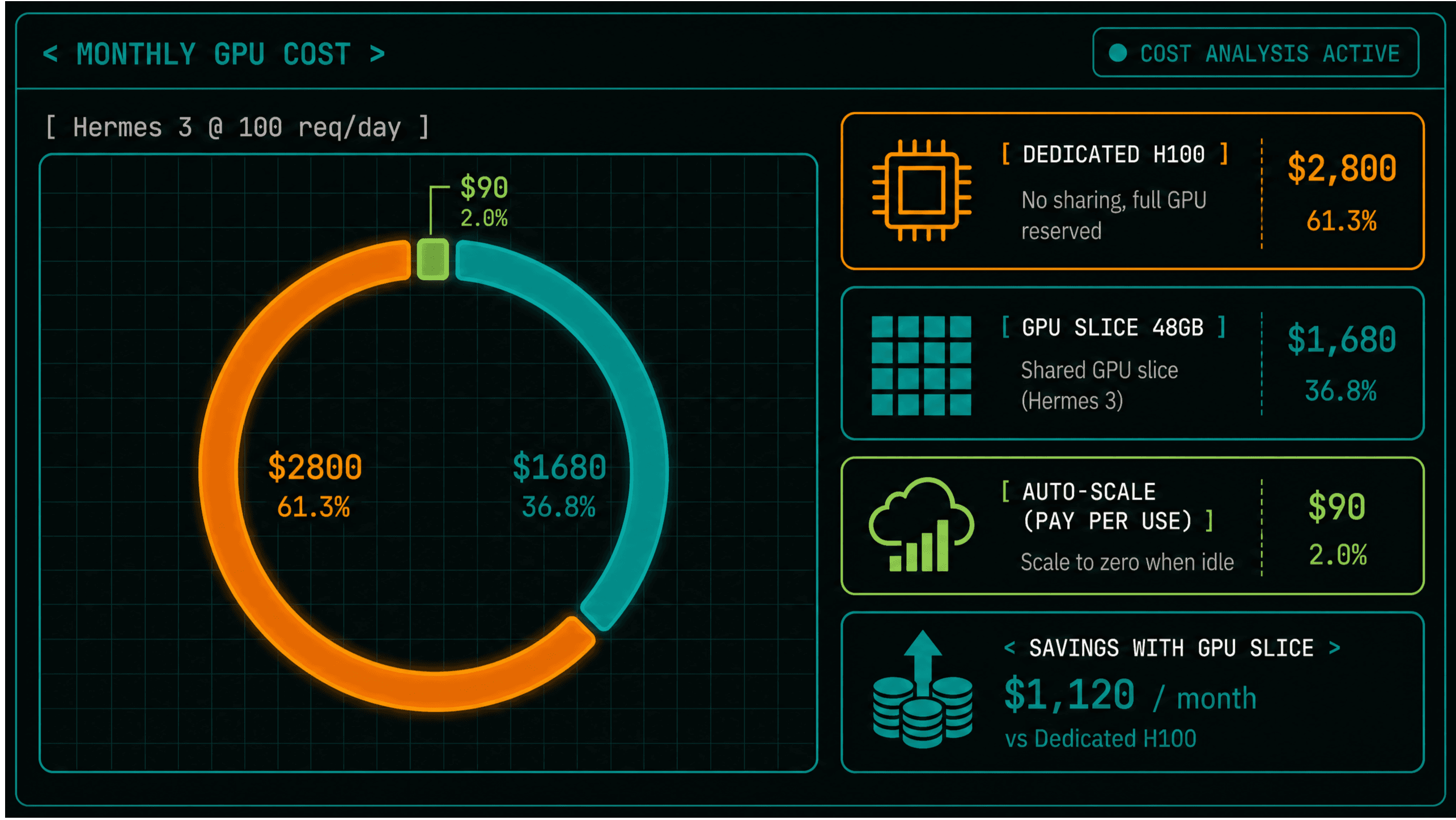
GPU Cost Dashboard
| Configuration | Monthly Cost (approx) |
|---|---|
| Dedicated H100 (80GB) | $2,800 |
| GPU slice, 48GB | $1,680 |
| GPU slice, 24GB | $840 |
| GPU slice, auto-scale (0-10 replicas) | Pay per second of actual use |
The auto-scale option costs nothing when idle. If Hermes serves 100 requests per day averaging 2 seconds each, you pay for roughly 3.3 GPU-minutes per day — about $3/month.
Next Steps
Once Hermes is running, you can:
- Add more replicas for higher throughput: set
scale.replicas: 3 - Enable streaming for real-time token output: add
streaming.enabled: true - Set up auto-scaling: add
min-replicas: 0, max-replicas: 5and the platform handles the rest - Fine-tune Hermes on your own data (see our fine-tuning guide)
Read Next
Deep dives into infrastructure and AI.
Tutorial
Aug 4, 20264 minutes
Run OpenClaw with Ollama Serving Qwen3.6 on a Full H100: No Token Limits, No API Bills
Deploy OpenClaw and Ollama as two separate pods on Istidlal, connect them over public URLs, and run Qwen3.6 35B with no per-token costs and no context ceiling.
Read Article
Tutorial
Aug 3, 20262 min
Run your Local Jupyter Notebooks on ANY remote GPU directly from VSCode
Eliminate the tedious setup and constant context switching required to run Jupyter notebooks on remote GPUs directly from VSCode using Istidlal extension
Read Article
Infrastructure
Jul 28, 20266 min read
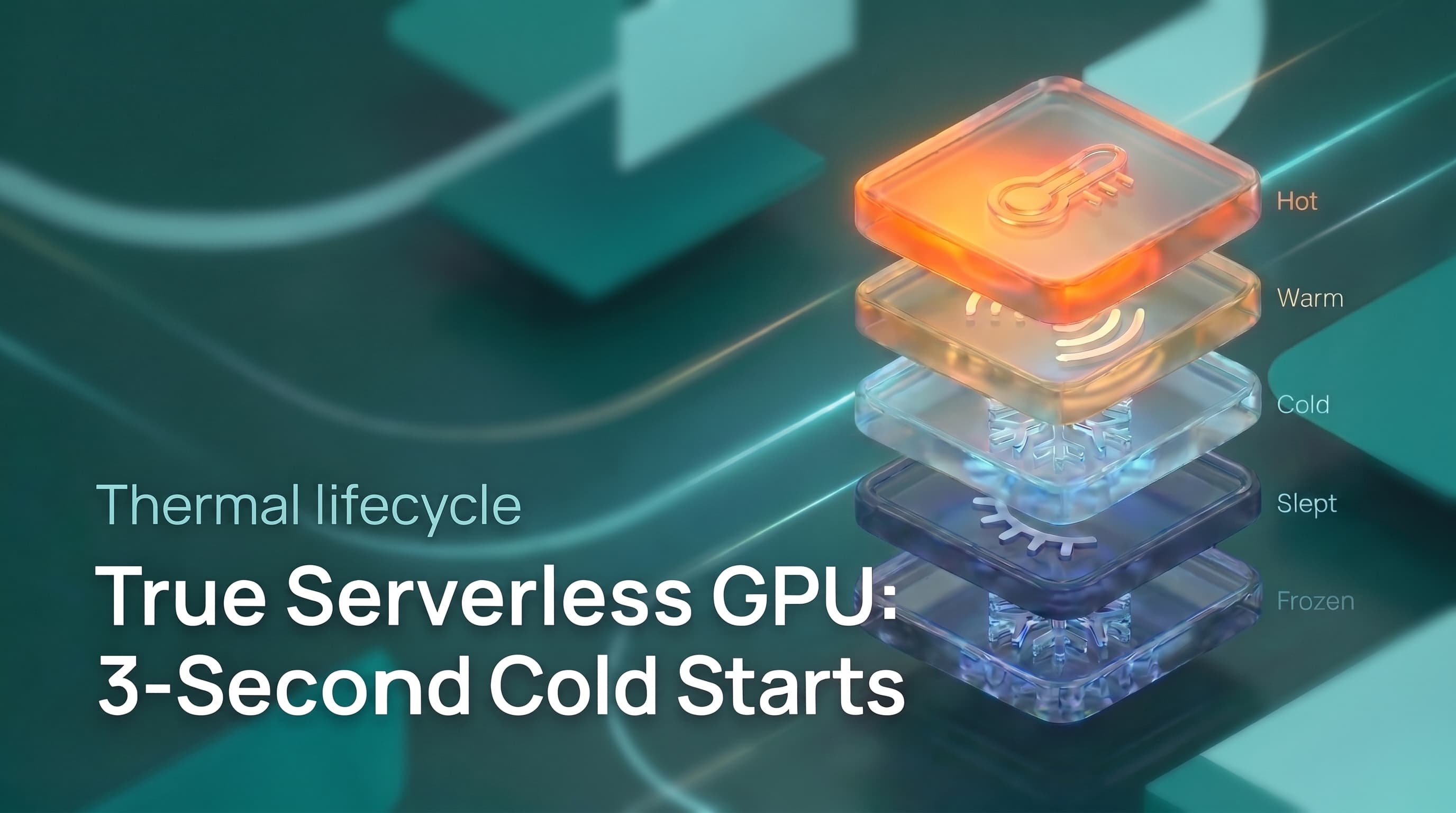
True Serverless GPU: 3-Second Cold Starts, Hot and Cold Serving
Discover how five compounded optimizations enable 3-second GPU cold starts and true serverless economics for inference workloads.
Read Article